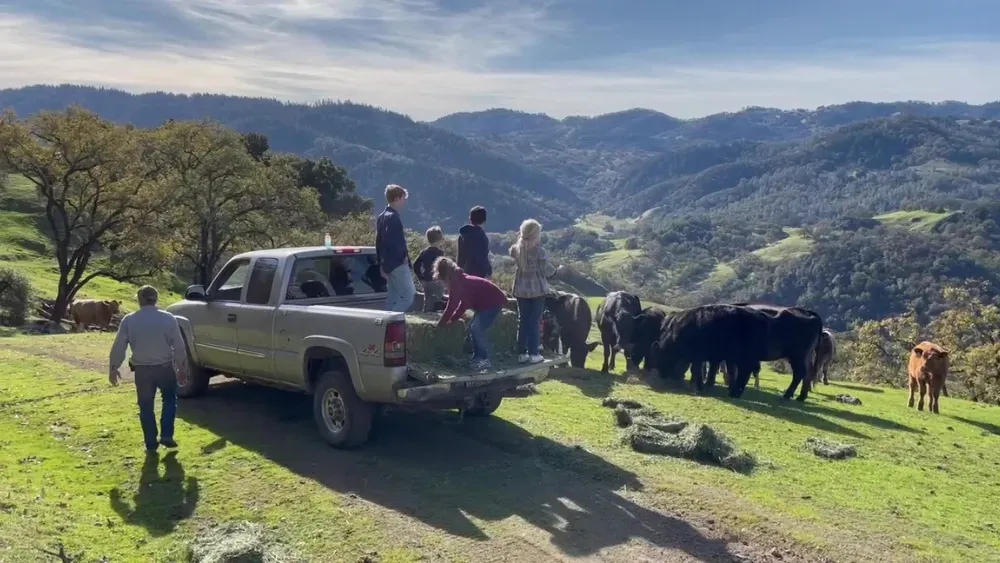
First I want to thank my partner Lost Canyon Cattle Company (LC3) here in Northern California who raises Akaushi Wagyu and produces high quality meat for those looking for that level of beef here on the West Coast. I have been on the ranch, seen the cattle roaming over the gorgeous property in the hills and received a ton of education on the “Wagyu” raising process and the many different ways (just like BBQ) that things can be done in that industry.
I have spent years researching “Wagyu“ and what it really means or doesn’t mean to consumers and to those like myself who have purchased and processed whole cattle. I’m not a butcher, just a very informed consumer who decided to take a deep dive into the world of meat since spending thousands of dollars on a cow is no small endeavor not to mention the dozens of ways you can have it processed. I hope this article (video) can provide you a single source of information which I could not find when I was learning about the subject.
‘WAGYU’ refers to all Japanese beef cattle, where ‘Wa’ means Japanese and ‘gyu’ means cow. Wagyu were originally draft animals used in agriculture and were selected for their physical endurance. Today in the United States, everyone wants to sell “Wagyu” leading you to believe it’s that incredible beef from Japan that has the insane marbling and prized for its incredible quality. BUT IS IT REALLY?
Wagyu has been bred for centuries to produce the highest quality beef. It’s prized for its marbling scores, which are an indication of the amount of fat distributed throughout the meat among other factors I will get into shortly.
Unfortunately, some people have exploited this name and sell products under the label Wagyu which isn’t technically wrong since it’s just a cow but it’s a misleading marketing trick SOME do to get you to pay higher prices than you should. This is known as what I call The Great Wagyu Conundrum! I’m going to explore how to tell if you’re getting genuine Japanese, Australian beef or American Wagyu and what you should be looking out for when purchasing it.
I have seen many people on social media posting photos of them with “Wagyu” which in many cases looked like a nice prime black angus cut of beef, but you can’t really tell by pictures many times although you can tell by the price they show they are certainly hoping it’s “Wagyu”. First if you are buying “Wagyu” you are just buying beef and nothing more. Without seeing the certifications and knowing where that animal came from and its genetics, you really don’t know if you are getting an extremely highly graded BMS 5+Black Angus Prime cut of U.S. beef or a Japanese lineage of cattle such as Tajima Black, Akaushi, Kobe, and so on. That doesn’t mean it’s not good, it just means it’s not what you think it is and while some might not care, when you are spending 150.00 retail for one steak, or $1200.00 for one tenderloin, I damn well want to know more about that cut of meat.
So how do you know you are getting the highest graded meat on whatever named category of meat you are buying? You need to know the BMS to answer that question and every cut of Japanese Wagyu that is pure bred in Japan here in the U.S. comes with an official birth certification or certification you should be able to ask for (especially in restaurants that sell it, they should show you upon request).
Before we get into specific grading systems, we need to know how meat is graded. Steers (or the male cows) are graded based on the amount and distribution of marbling in the ribeye muscle at the cut surface after the carcass has been ribbed between the 12th and 13th ribs.
Although the meat is graded there, that does not mean every cut of the animal is going to look like what is seen between the 12th and 13th rib. Just because the ribeye gets an extremely high grading does not mean another cut of that same cow will show the same grading level, so knowing this helps you understand that not all cuts are equal. However, based on packaging and visual inspection you’ll be able to see very quickly if that cut appears to be as high as it’s rated after looking at enough graded beef.
So, let’s get into each grading system so you can see the differences between a broad range grading system like the U.S. and a more defined system like the AGS from Australia or the grading system from Japan. And to confuse you even more, the U.S. system only goes to BMS 5+, the AGS to BMS 9 and the Japanese system which goes to BMS 12. Probably more information than most people want to know but since I have purchased a whole cow to process, I really wanted to know what I was getting into. When you are buying a steer for $6000.00, you better damn well know what you are getting and to be honest, at first, I really wasn’t sure and had to trust the rancher which in my case worked out incredibly well.
So, let’s talk about the BMS
There is a master grading scale called the BMS or Beef Marbling Score to which all other countries align their scores but call it different names. Sounds confusing, doesn’t it? There is the IGS, AGS and U.S. and the IGS, AGS and U.S. all have scores that equate to a level on the BMS chart. Beef quality grading varies by country. In the US, the USDA grading is USDA Prime, USDA Choice, USDA Select, while other countries use letters, numbers, or a combination.
On an international scale, the predominant grading systems are the ones used in Australia and Japan. The common indicator across these Beef Grading Sytems is the BMS or Beef Marbling Score.
So, what is the Beef Marbling Score?
Marbling is the white fat that can be seen in the meat muscle evaluated on a cut of beef. Marbling is vital for quality measurement of tenderness, juiciness, richness, and especially the Wagyu eating experience. This score is called “Beef Marbling Score”.
The most predominant beef in North America is the Angus beef or Black Angus, and it averages a BMS of 2 but can reach maximums of 5. Grass-fed beef will usually grade Choice at best due to their extreme lack of fat compared to grain fed and finished cattle.
Now, let’s go with the least descriptive store labels you will find here in the U.S. The U.S. Grading scale is broken down into 3 main consumer categories. I say this as there are other descriptors but to stay on topic, I’m going to address the main three. Prime, Select and Choice.
Prime is the highest rated cut of meat you will find at the grocery store or Costco with the U.S. Labeling System. The BMS score on this meat at the highest level is 5+ which is MUCH lower than the high end of the Australian or Japanese BMS scores you can buy.
So how do you know you are really getting Prime vs. Select? After the meat is inspected for wholesomeness, producers and processors may request to have the products graded for quality by a federal grader. The USDA’s Agricultural Marketing Service is the agency responsible for grading meat and poultry. I can tell you I have bought Choice brisket at Costco which visually was so close to Prime, you’d never know the difference if it was cooked to perfection. So, when it comes to the U.S., Choice is a labeled or graded inferior quality cut of meat compared to Prime. You can tell Select as there is little to no marbling when you visually inspect the meat. Select is the lowest grading on beef you will find in a retail store and will definitely be the lowest quality (And cheapest) when it comes to marbling and flavor but doesn’t mean it’s “bad beef”.
When it comes to Prime there are many ranchers who raise solely pure-bred Black Angus with BMS scores of 5+ which equate to a low A4 on the Japanese scale as long as it meets the other qualities you will find in the Japanese grading chart below. It is still AMAZING. I’d take a Prime 5+ any day over an A3 Japanese cut of beef.
To get even high-quality intramuscular marbling, you need to look at 3 main factors. The steer’s genetics, the type of feed being fed, and how long the cattle are being fed. I won’t get into grass vs. grain but I will tell you grain finished cattle in my opinion are much tastier, tender and have that fat that’s delicious. Grass fed cattle, not so much in my opinion, but it’s just an opinion.
Let’s get into the next grading system, the AGS or Australian Grading System as it was called is now known as the MSA. The Australian beef grading system is known as Meat Standards Australia (or MSA) and is regulated by Meat and Livestock Australia (MLA).
The MSA is a relatively new grading system, and it is not very popular (yet). When calculating the MSA grade for beef, several attributes are measured such as meat color, marbling, fat depth, carcass weight, maturity, and ph… it is very comprehensive.
The MSA marbling system is graded on a scale of 100 (no intramuscular fat) to 1190 (extreme amounts of intramuscular fat) in increments of 10. How they got those numbers I have no idea and it’s only important to know those are the numbers.
The older standard is the AUS-MEAT grading, goes from 0 to 9. It is VERY similar to BMS as it provides an indication of the amount of marbling in beef. It uses a scale of 0 (no intramuscular fat) to 9 (extreme amounts of intramuscular fat) in increments of 1. Many times, you will see or hear people say it’s an 8/9 or 7/8 which if they are talking about Australian beef, you know they are using the older rating scale and it is high quality. That may eventually change with the new MSA, but we’ll have to see years from now to make that determination since the AGS is so embedded with consumers.
The Japanese Beef Quality System
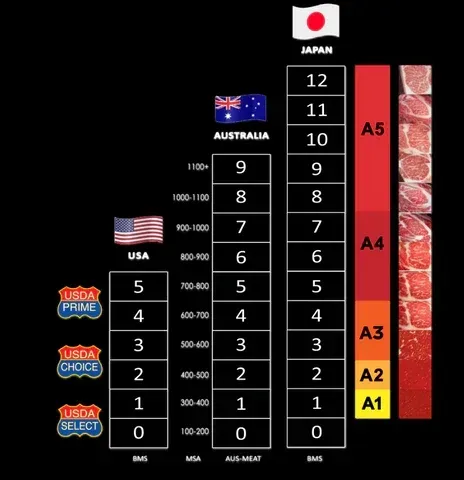
The Japanese system is the most detailed grading system and in some ways the most complex as well if you look at the chart below. The grading of meat is managed by the JMGA (Japanese Meat Grading Association) Beef Carcass Grading Standard.
The overall grade consists of two grades: Yield Grade (designated by a letter) and Quality Grade (designated by a number).
Yield Grade measures the amount of usable meat on a carcass and range from A (the highest) to C (the lowest).
“A” usually means the cow was a full-blood Wagyu. “B” is usually a crossbred Wagyu. “C” is usually for Angus or Holstein cattle.
Quality grade is calculated by evaluating four different factors:
1) Meat marbling
2) Meat color and brightness
3) Meat firmness and texture and
4) Fat color, luster, and quality.
If you want the King of Japanese Pure-Bred Wagyu, you will want the A5, although that meat may not be the best for grilling on a grill grate over open fire. You may be surprised to learn that in Japan, Wagyu beef is often consumed completely raw. The cooking methods range from thin strips raw by themselves, to dishes like the slow-cooked one-pot meal sukiyaki or broth dishes like shabu-shabu. However, one of the most popular ways is on a communal flat grill (think hibachi grill) or an iron pan heated over charcoal. At my home when I have purchased A5 Wagyu,
I literally stood at the stove over my iron pan and ate every piece as it came out of the pan. There is no resting period with this beef!
The Japanese feel Japanese pure-bred cattle is best cooked rare and no more than medium rare (on the rare end of that spectrum). If you have not purchased A5 Wagyu from Japan or Australian AMS 9, do yourself a favor and buy yourself something special. There are many importers you can purchase from online.
Please subscribe to my blog for more!
SMOKE ON, BABY!